Inclusion with Adam Mico
Welcome to "What's Good?" Season 2!
Hi all,
Welcome back to a new year, new content, and new guests. Conventionally individuals tend to reflect on their life in January in terms of setting goals and aims for the year. When it comes to this, a little secret of mine is making sure I’m surrounded by good friends, talent and positive influences. They say you are the combination of the 5 people closest to you in life.
CJ: What really touched me in the video is when you said “As long as your heart is pure and as long as you want to contribute and work hard to be an impactful member of the community you could really be a part of something” - Is there anyone in the community you’d like to call out for having an impact on either you, or in the wider community? (LINK)
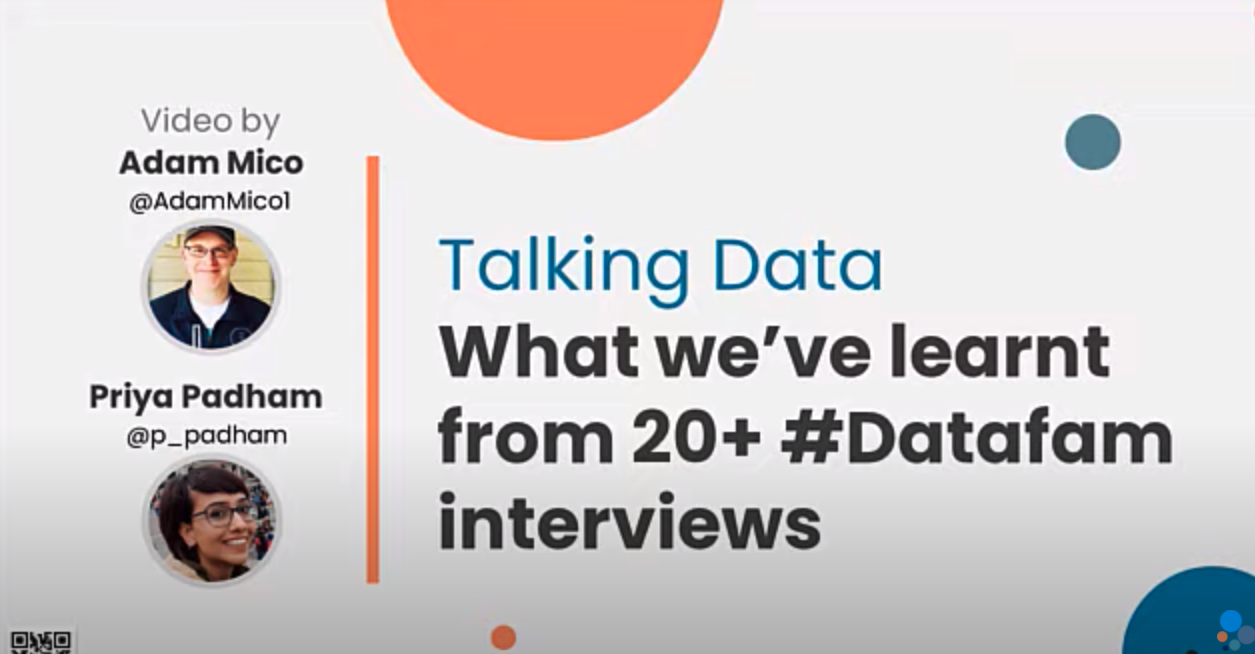
A: There are really so many. I have to start with those not mentioned explicitly, who ushered me in. My community story began before Twitter and that was Toan Hoang’s Tableau Magic Facebook Group. He helped me understand I could have impact on a greater community and supported my work in his. Once I joined the community, Zach Bowders immediately be-friended me; he was my 1st community Tableau Public follow, Twitter follow, and collaborator. Michelle Frayman was a person I could talk to in order for me to better understand the workings of it. Sarah Bartlett and Kevin Flerlage were two community leaders who encouraged me to contribute and were very generous with their time and friendship with me.
However, I cannot fail to mention my #DataFam partner for over a year and a half, and that is Priya Padham – not only was my 1st community mentee I got a chance to work with, she became my most frequent collaborator and one of my best friends. Seeing her growth and excellence in the face of challenge and self-doubt is so inspiring!
There are literally thousands more with hundreds having a life-altering impact. You know who you are and I thank you so much!
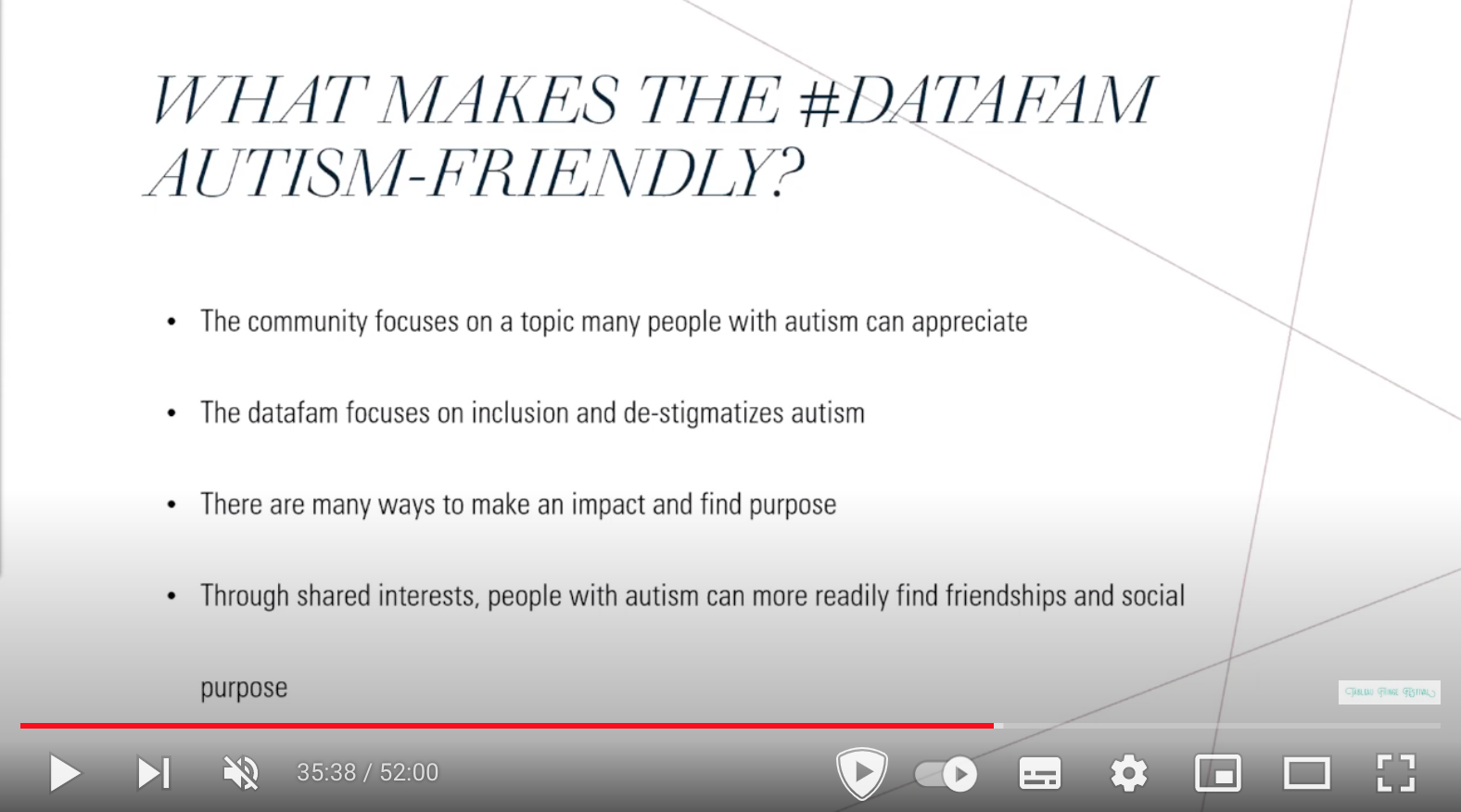
CJ: In recent years, whilst more to be done, there have been some genuine change in the workplace in relation to gender and racial discrimination, do you think the same can be said in regards to neurodiversity as a whole?
A: That’s an interesting question. I would love to say, “yeah, totally”, but that’s not honest. I talk to people all the time afraid to share being neurodiverse because there is still a stigma attached to it. In diversity and inclusion talks, it’s often disregarded in that umbrella and is considered its own thing. I believe it will help when people stop considering neurodiverse a handicap. I believe the conversation really begins when people are better educated on neurodiversity and consider the positive influence neurodiversity has on their work and life-enrichment.
As for employers, they can help out neurodiverse staff by:
-
Educating themselves on neurodiversity. I would suggest subscribing to Hunter Hansen’s YouTube Channel as he provides insightful and well-organized videos to help better understand the autistic experiences in life and work.
-
Do not try to force someone to come out to you as a neurodiverse person. If one does, realize it is likely very difficult for them to do and it’s important for them to share. It’s imperative that they know you support them, will listen to them, and make sure you will make sure to accommodate needs. On a related note, and should go without saying, but if the person shared this information with you privately, do not share with others.
-
Allow for people to be themselves. There are unwritten rules of etiquette that do not make sense to many neurodiverse people. If something needs to be corrected, make sure it’s done privately.
-
Reduce ad-hoc pop-ins. Many neurodiverse people need to have time to prepare for meetings, tasks and so forth. It’s understandable when things are urgent, but try to allow for as much buffer as possible for preparation purposes. Even if people do not need to create material for meetings – mentally adjusting to neurotypical environments is taxing and having time to mentally prepare helps reduce anxiety (and allows for stronger contributions).
-
Optional events that require a lot of social interaction should not be quasi-required – meaning that if people do not need to show up, they may not because it’s not comfortable to them – confronted them with sarcasm or inquiring about whereabouts (even in jest) can make the person feel even more uncomfortable. A specific related example is videoconferencing meetings – people may choose to put on their cameras or leave them off - if there is no requirement for a camera to be on, then it do not challenge a person for not having a camera on (even if private) because it impacts their ability to be comfortable and contribute.
With those notes and since the pandemic, remote work has helped those reduce the number of unwritten rules. Employees have flexibility in correspondence and attire with less in-person requirements and pop-ins. This environment, overall, in many cases have helped many neurodiverse people to feel they have space and a little comfort being their genuine selves and contributors.
CJ: You are constantly uplifting others in the community, and were recently chosen (for the second year running!) for The Michael W. Cristiani Community Leadership Award, alongside Michelle Frayman. Is being uplifting of others one of your most important values?
A: My most important values are being genuine and humble, contributing value, and amplifying others. Until 2021, I rarely shared anything that was just me. It was about working with others, amplifying voices, and creating visualization while building friendships. I wanted to make sure people were heard, supported, and wanted to feel like they were part of the greatest community in the world. Although my content has changed significantly in 2021, those still hold true.
CJ: Whilst Data21 Tableau Conference must feel like so long ago now, you had written a blog as part of the data leadership collaborative on why brain dates are awesome. Was this your favourite part of TC21 this year? What advice would you give community members that are maybe a little too nervous to reach out to members of the community? (LINK)
A: This year, my highlight was definitely hanging out with some amazing #DataFam at #TC21CabinEdition. As for the conference itself, Braindates remain my favorite thing; particularly one-on-one braindates. It gives you an opportunity to connect and really assist people in a comfortable environment.
I encourage anyone to dive in when available. The topics are incredible and give you an opportunity to meet selfless people who want to share knowledge. You will learn quickly that the people offering the braindates do not care about your followers and is not an inconvenience to them as they opened up time to chat about the topic they want. I would have been nervous to meet anyone in this way before 2019 and talked to many who were initially nervous, but the experiences I have had or talked to others about have been immeasurably valuable.
CJ: You give back to the community in many ways, one of which is helping facilitate the mentoring program. In fact, I had the pleasure of first meeting Kate Brown because of it. What prompted you to start the mentoring program?
A: Other people started the program or various versions of it long before I did. When I contributed, I just understood there wasn’t a structure in place to last beyond an initial pairing. It takes a lot of time to do it well and there will always be hiccups. This iterations involved people mentioned here and Brian Moore joined a little later.
In 2022, we plan to relaunch to touch on some of those spots, while trying to help support it. Please look out for it!
CJ: Your piece on overcoming imposter syndrome that was featured on towards data science particularly resonated with me. I really enjoyed hearing your own tips and thought management around the topic. When you mention that the community can be overwhelming at times due to the amount of content and learning opportunities, have you found any ways to help navigate this sense of constant reading, practicing and learning? (LINK)
A: I am a bit of a different case and just search my feed for a lot of this, but the easiest way to do this is to review the weekly and monthly round-ups. The monthly version usually is published within a week of the month’s closure. Ateken Abla is a community content specialist with Tableau and curates a weekly list (usually published on Fridays) of content that provides a user many opportunities to read and review different types of content (even in non-English). It pairs down the content a little while giving you the best to work with.
Mainly, you need to set learning and content goals while allowing yourself some breaks when life gets in the way. It’s best to consider learning a lifetime path that doesn’t let up because you are a certain age. Making that commitment to yourself not only helps you reach goals otherwise unimaginable, but helps so many others along your journey.
CJ: You took part in many of the WebDuBois’ challenges on Tableau Public. What made you want to get involved? They look very technically challenging! Was there anything particular that stood out from completing them?
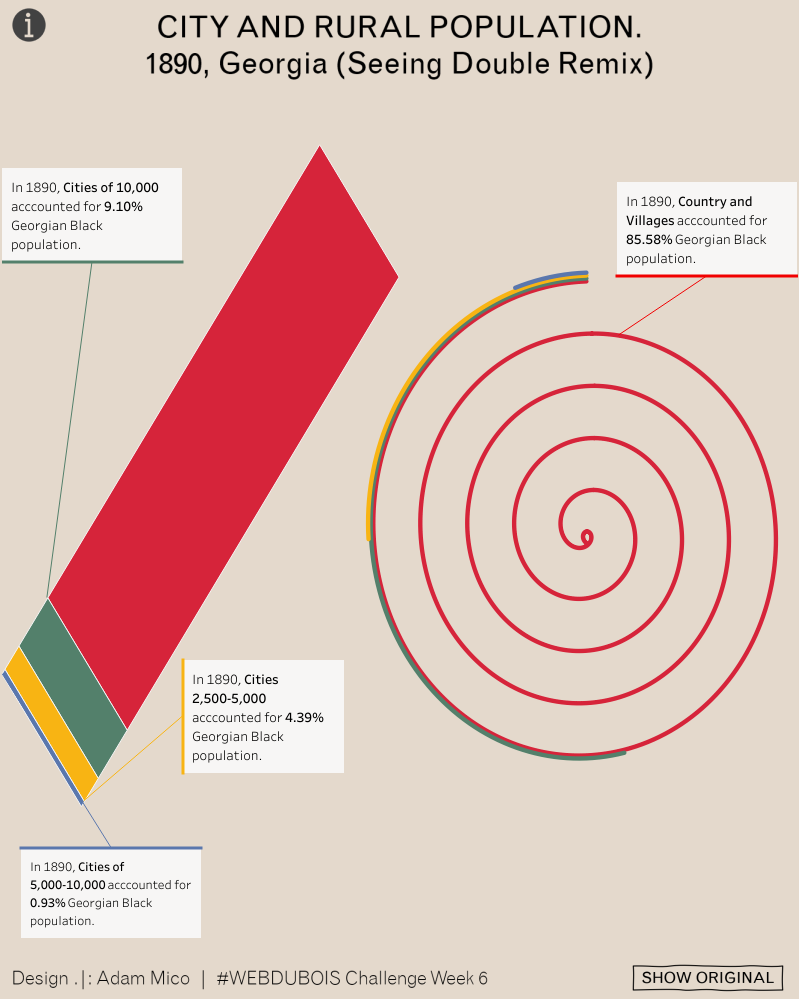
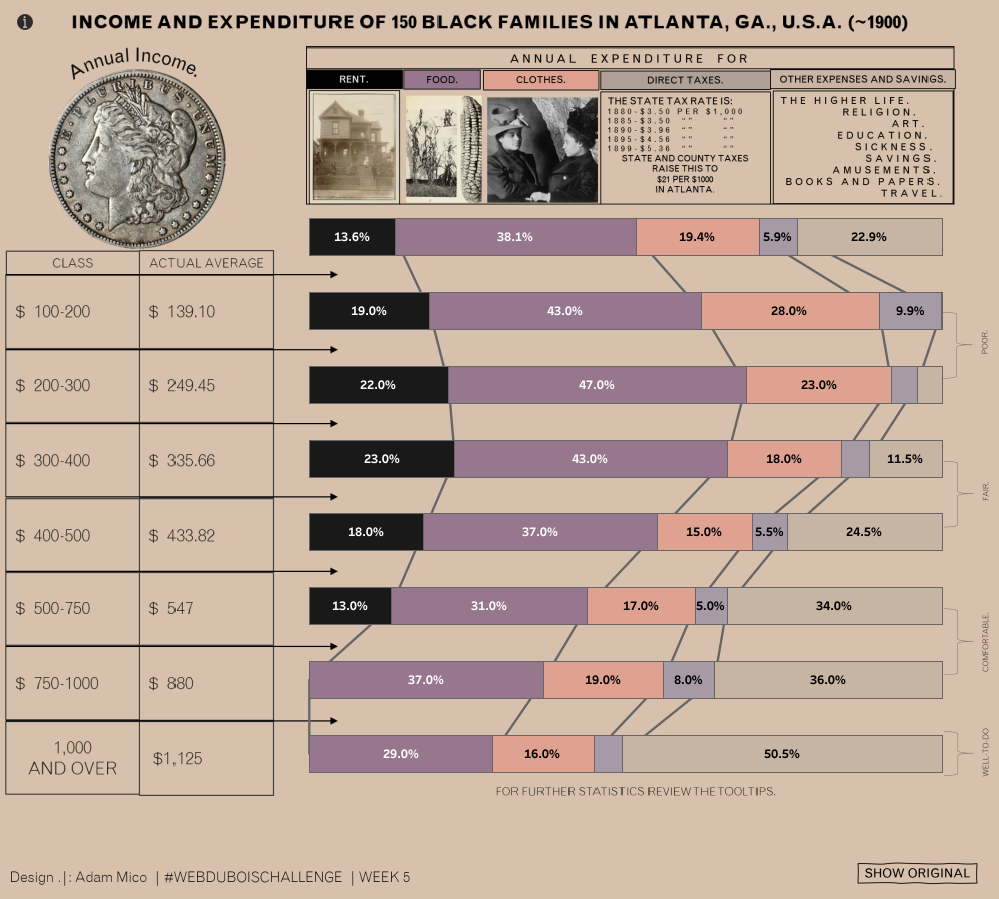
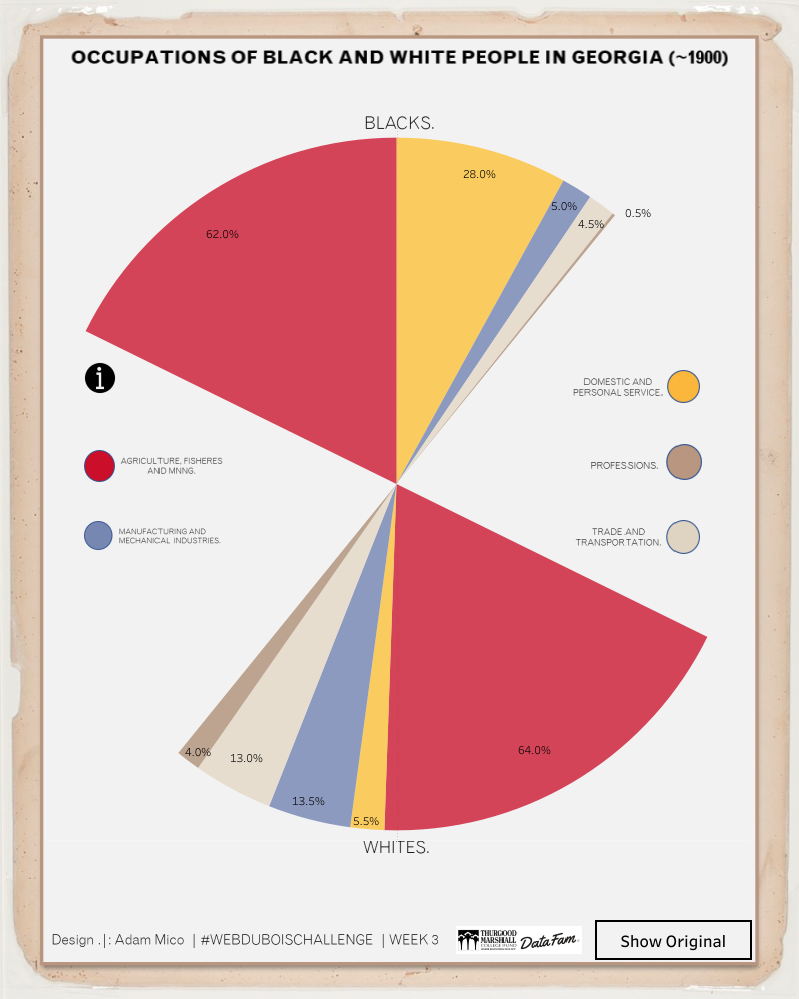
A: I loved the infographics. In addition, I love history. Combining both, while challenging myself in Tableau was an experience I could not pass up. The more involved I got, the more I could see the world through DuBois’ lense. It made really consider how he visualized it in his head, how novel it was, and deeper thinking about the challenges it was to gather this data. I shared this and learned more when I interviewed the project leaders: Allen Hillery, Sekou Tyler, and Anthony Starks about the initiative.
CJ: You’ve been doing more content around Salesforce and Tableau CRM. Congratulations on becoming a TCRM / Einstein Analytics Consultant. Can you give us a little detail as to what it is and how it works? (LINK)
A: Tableau CRM is an AI-driven analytics tool in the Salesforce family (as Tableau is). However, it’s its own platform and tool. It helps end users make predictions on items based on learning it’s data and generates models based on it. It can connect to Salesforce or Tableau.
In Salesforce, it’s effective for helping determine predictions and improvements of a primary question as it relates to a specific question.
For example if you want to maximize the likelihood of a person signing a contract. It looks at the fields, reviews correlations, and other items to determine it. At the record level, you can utilize parameters to help maximize it (or to determine if it’s an opportunity you would like to commit).
In Tableau, you can use Tableau, with the use of the Extension object, to look at the predictions and improvements of many rows of data to gather more exploratory opportunities.
Another example would be consider you are working with thousands of records. You are looking for ways to minimize late shipments during the holidays. You can filter to specific dates, review filters of shipping companies and etc. to determine the best overall balance to reduce late shipments of many orders.
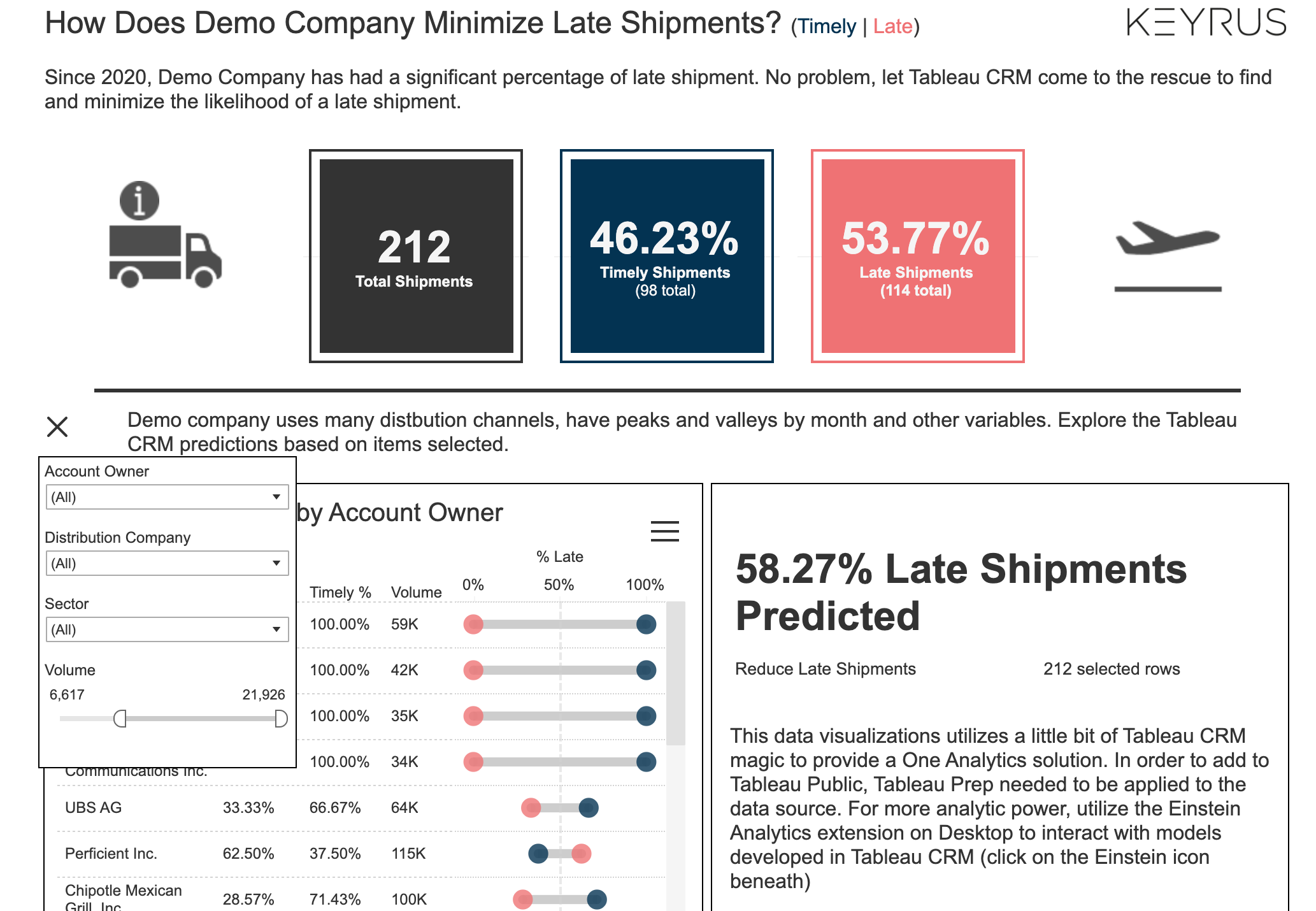
CJ: You can view a working example of Adam's dashboard here. I think for me, Tableau CRM is a seen as a fairly new concept to many of us in the community but it's great to shed light on it. What I do like is the idea of creating models integrated within Tableau. Often we see data scientists create their models outside of Tableau (in code somewhere) and end up having to re run them a number of times over to show different scenarios to then have data visualisation as an end point or 'nice to have', bringing these two features closer together in a more harmonious way is great. If you'd like to see more about Tableau CRM check out this link. This is definitely an area I would like to learn more so would be good to see if there are any working groups around it!
CJ: In the interest of upskilling, do you have any pointers or learning areas for those that are new to these tools? (LINK)
A: Yes. Besides the tools mentioned earlier, I want to give a shout-out to Trailhead. Most of the learning is free, well-designed to help you learn with a combination of text, hands-on, and video with excellent pacing. They are also beginning to share Tableau content too!
CJ: Is there any exciting plans you want to share for what this year has in store?
A: Besides what I mentioned above with MentoringMeetup, Priya and I will relaunch DataFam interviews in 2022. I will also work with KT on a secret huge project in 2022!
CJ Round-up:
I really enjoyed sitting down and learning more about neurodiversity with Adam in this months blog, especially watching some of the co-presented youtube videos with Hunter. Accessibility in general is something we should all make a conscious effort to think about more.
Adam shares some great learning resources in terms of those wanting to kickstart either there Tableau public work through the weekly round up by Ateken (I personally LOVE these!) as well as some more formal training when it comes to Tableau CRM and salesforce learning. Do make sure to check them out! Thanks Adam, wishing you a successful 2022 - looking forward to the new dataFam interviews of newcomers to the community.
LOGGING OFF,
CJ